
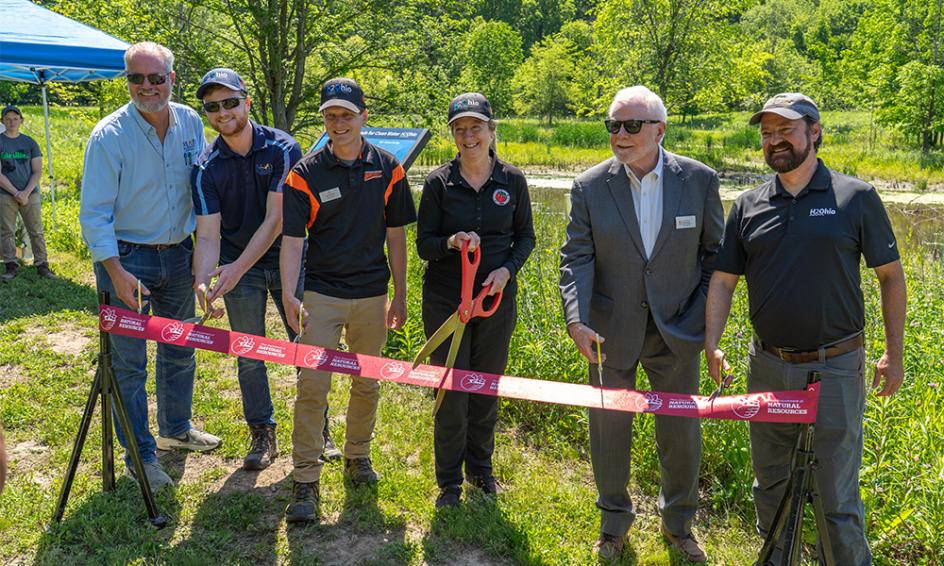
Heidelberg University officially opened the Funk-Dewald Nature Preserve near Bascom, just outside of Tiffin, May 28, marking the completion of a major wetland restoration project decades in the making.
A gift that grew
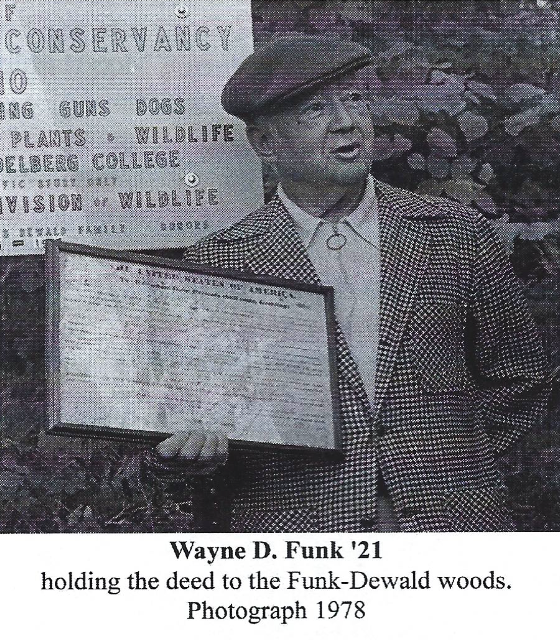
The Funk-Dewald Nature Preserve has a rich history dating back to 1835, when Wayne D. Funk's great-grandfather, John Dewald, purchased a 40-acre tract of land from the U.S. government for $1.25 per acre. A French army veteran who survived Napoleon's ill-fated 1812 invasion of Russia, Dewald immigrated to the United States with his wife from Strasbourg, France, and the land remained in the family for generations.
In 1978, Funk, who graduated from then-Heidelberg College in 1921, donated 20 acres of this historic family land to the College to preserve as a natural sanctuary. He also presented the College with a remarkable piece of history: the property's original 1835 deed, bearing the authentic signature of President Andrew Jackson.
Restoring nature, together
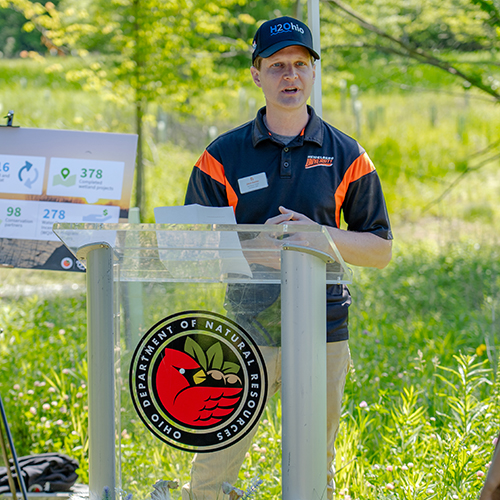
Wetlands do heavy lifting for the environment, naturally filtering nutrients and pollutants before they reach local waterways and Lake Erie, absorbing stormwater to reduce flooding, and providing essential habitat for native plants and wildlife. Bringing that vision to life required a strong coalition: Heidelberg's National Center for Water Quality Research (NCWQR), the Ohio Department of Natural Resources (ODNR), MAD Scientist Associates LLC, and Seneca County Parks all partnered to make the restoration a reality.
The NCWQR received a grant of nearly $450,000 to fund the restoration of the nature preserve through the H2Ohio Initiative. This initiative, launched in 2019 by Ohio Governor Mike DeWine, focuses on improving water quality and protecting Ohio’s vital water resources to ensure clean, safe water for future generations. ODNR’s role in the H2Ohio Initiative includes improving, restoring, and expanding wetland areas throughout the state.
Heidelberg’s project – led by Jake Boehler, NCWQR field manager and Sandusky River Watershed Coalition coordinator – involved restoring 16 of the nature preserve’s 47 acres to a wetland, preserving healthy ecosystems such as the mature old-growth forest that was already functioning effectively.
More than a nature preserve
The site is designed to be a living classroom. Heidelberg hopes local schools and community organizations will use it for hands-on learning, giving students of all ages direct access to wetland ecosystems and water quality research in action. Following the ribbon-cutting, attendees toured the preserve to explore its restored wetland features and learn about the long-term vision for the site.
Want to support Ohio's water quality efforts? Learn more at h2.ohio.gov.