
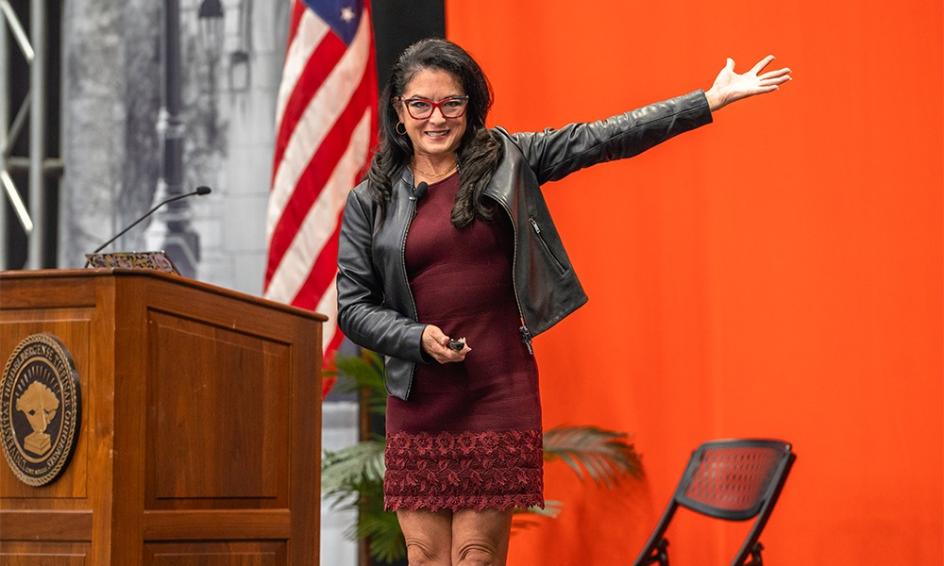
For Dr. Vonda Wright, a career is not a straight line. It is a collection of experiences, risks, reinventions and unexpected turns — each chapter preparing you for the next.
That was the message Wright brought to Heidelberg University Thursday night as the keynote speaker for the Fall 2026 Patricia Adams Lecture Series. But her visit to campus was about more than her keynote.
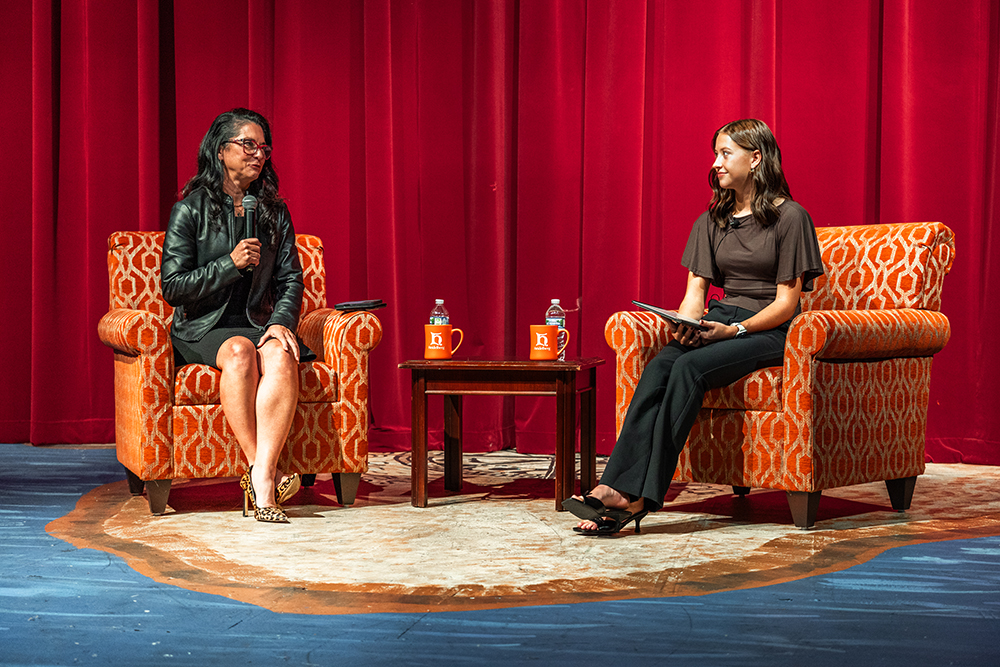
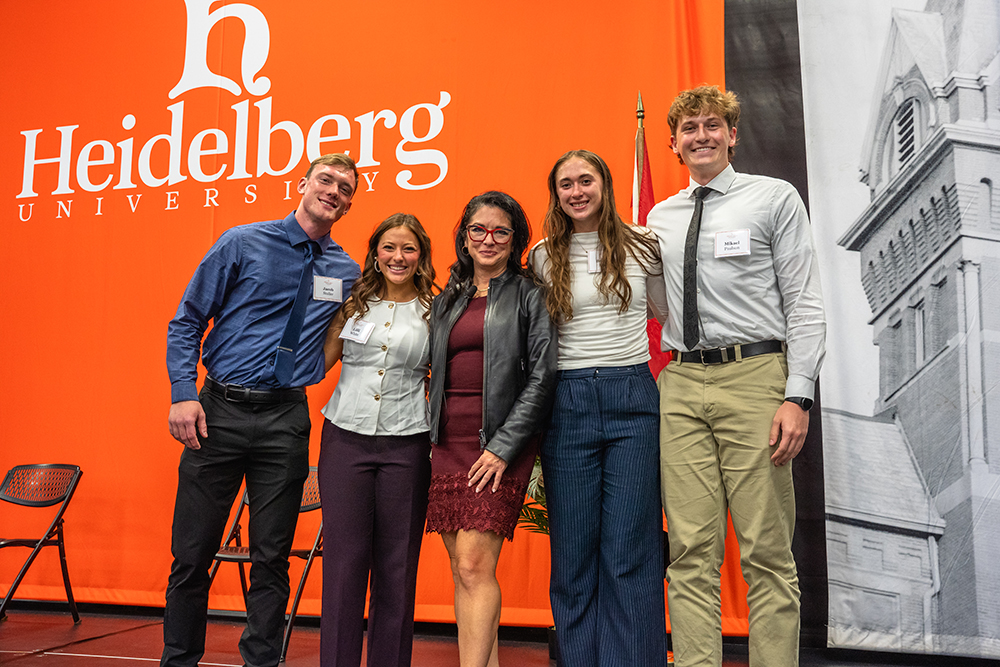
Throughout the day, the pioneering orthopedic sports surgeon, human performance expert, researcher and women’s health advocate met with Heidelberg students in smaller sessions, answering questions and talking openly about the winding path that took her from a small Kansas farm town to the forefront of sports medicine and women’s health.
“I’ve had the most amazing sessions with students,” said Wright, the first M.D. guest of PALS, which began in 2010. “You asked me some great questions, and I got to speak from the passion of my heart.”
Her keynote, “The Long Game: A Sports Doc’s Playbook – 1991-Today,” allowed her to talk more about the story behind her career and less about the science of elite sports medicine and human performance for which she is known.
Wright grew up on a farm in Kansas, in a town of about 2,000 people. Her high school graduating class had 85 students. Her parents were first-generation college students, and Wright learned early that education could be a path to something more.
“I’ve always wanted a big life,” she said. But she didn't know exactly what that would look like.
Her first job in medicine was as an oncology nurse. Later she returned to school, earning a master’s degree in oncology nursing from Rush University before attending the University of Chicago-Pritzker School of Medicine. She completed her orthopedic residency at the University of Pittsburgh and a sports medicine fellowship at the Hospital for Special Surgery in New York.
Each step prepared her for the next. “Every step of my career was preparing me for the next — increasing my range, increasing my skill set.”
Today, Wright’s career sits at what she calls a “weird intersection” of orthopedics and human performance, aging and longevity, and whole health for women.
“I still do ortho. I still do surgery,” she said. Within surgery, Wright considers herself an innovator and promoter of technology. But her primary role, she said, is something even more fundamental. “My primary job really is an educator,” she said. “I teach people to make decisions that are best for their lives.”
Giving athletes their dreams back
For more than 25 years, Wright has cared for more than 100,000 patients and become a prominent voice in sports medicine and human performance.
She has served as the founding Chief of Sports Medicine at Northside Health System and inaugural Medical Director of the UPMC Lemieux Sports Complex. Her work has included caring for athletes connected to the University of Pittsburgh, Georgia State University, the Pittsburgh and Atlanta Ballets, World Rugby and the PGA.
The privilege of working with athletes goes beyond the thrill of sports. “It’s not only fun to be a sports doc, but meaningful to give someone their dream back.”
The goal is not simply to repair an injury or treat a condition. It is to help patients return to the life they envisioned for themselves. That philosophy eventually led Wright into another defining area of her career: women’s health.
Building the platform that didn't exist
In 2013, Wright began focusing more intensely on the whole health of women.
She had become fascinated by what happens to women’s musculoskeletal systems during menopause, including changes in bone density, muscle mass and weight. As she experienced menopause herself, she realized how little comprehensive research existed on the physical, physiological, hormonal and social changes women experience.
“The need is so great, and there was no platform,” she said.
Her response was classic Wright. “You’ve got to go build it,” she said. “Don’t get permission. Just go change the world.”
She authored a highly influential research paper around the concept she calls “meno-lescence,” examining the effects of menopause on women’s musculoskeletal systems as estrogen levels decline.
For Wright, mobility is central to longevity. Maintaining mobility helps people remain active and participate in the lives they envision for themselves. “I’ve always known that saving mobility means saving lives,” Wright said. “That is my ‘why.’”
Four lessons from The Long Game
Looking back across more than three decades of her career, Wright distilled her experience into four lessons:
Dream big.
Wright didn't know at 23 that she would become an orthopedic surgeon. She didn't know at 28 exactly where her career would take her.
“What I did know is that I had the capacity to do more,” she said. “I just didn’t know how or what that was.”
Her advice: Don't dismiss the chapter you're in now. Absorb all of its pieces, because they may prepare you for something you cannot yet see.
Collect experiences.
Every job, degree, challenge and unexpected opportunity can become part of the next chapter, as illustrated by her own journey in which separate experiences have intersected.
Don’t let success trap you.
Wright shared the story of a major sports complex being developed as a partnership between the University of Pittsburgh and the Pittsburgh Penguins. She wanted to lead the project but was about to be bypassed for the job. So she took a risk, going directly to the project chair to make her case.
She got the job.
But eventually, she realized that the position had become her ceiling. She was qualified for a senior medical director position but was not promoted.
“I didn’t want my success to be my ceiling,” she said. “At 47, I knew I wasn’t done yet.”
Build access to the rooms you want access to.
If the room doesn't exist, Wright said, build it.
That philosophy became especially important in her work in women’s health. When she recognized the absence of a platform addressing the musculoskeletal impact of menopause, she didn't wait for someone else to create one.
She built it.
Using a Venn diagram during her keynote, Wright showed how the three major areas of her career — orthopedics and performance, aging and longevity, and whole health for women — have increasingly converged.
At the center is purpose.
Borrowing a phrase from the biblical story of Esther, Wright described the realization that brought those seemingly separate pieces together: “I was born for this,” she said.‘Who can I become next?’
At 59, Wright is still asking the question. That's perhaps the most important lesson of her Long Game: Remaining open to what comes next.
Wright has set an ambitious goal for her legacy: helping women preserve their mobility, vitality and ability to live fully as they age.
“It’s always been an uphill climb,” she said. “But I am going to keep teaching. I’m going to keep taking care of 90 million women so they can realize their vitality.”
She encouraged the Heidelberg students to keep dreaming, keep collecting experiences and remain open to the possibilities ahead. “When I think about the Long Game, I am willing to take the risk through all my experiences,” she said.
And then she returned to the question that continues to drive her own next chapter.
“We continue to dream big, to collect experiences and wonder, ‘Who can I become next? That is something that we can always keep with us.”